

“Page must’ve been crazy to give away a guitar like that”
Dec. 19, 2025, 9:15 a.m.
The unbelievable journey of Jimmy Page’s 1957 Gretsch 6120 that sold for more than $130,000
The story of Jimmy Page’s 1957 Gtetsch 6120 reads like a rock ’n’ roll legend — because it essentially is one. Once gifted by Page as a free competition prize, the same guitar resurfaced half a century later, selling at auction for well over £100,000. What made this instrument so special, and why did the Led Zeppelin icon decide to part with it in the first place?
A model shaped by bold innovation
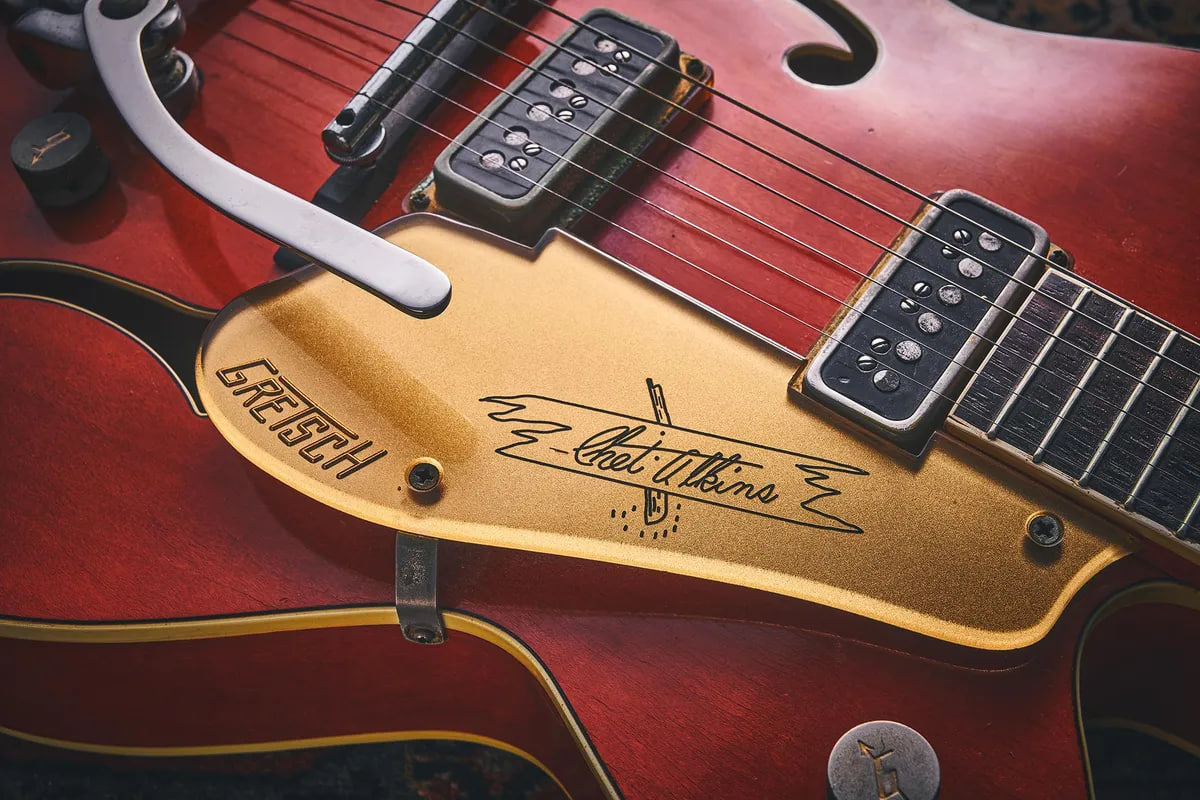
Unlike many electric guitars of the 50s that evolved gradually, Gtetsch made dramatic, sweeping updates to the 6120 from its debut in 1954 until 1961. Through these years, the company slimmed down the body, redesigned its internal bracing, changed neck-joint construction, introduced new pickup systems and reworked the wiring layout.
The look of the 6120 transformed as well. Western-style inlays gave way to hump blocks, then later to neo-classical thumbnails; the pickguards changed shape and placement; and the once-iconic “G” brand on the top was eventually abandoned.
Page’s guitar: right in the middle of a notable production run
Vintage expert Edward Ball traced the serial number of Page’s instrument — 23243 — to the middle of a 100-unit batch built in mid-1957. The confusing part: a Gtetsch “model year” referred to a set of features, not necessarily the actual manufacturing date. So guitars advertised as one model year could have been built months earlier.
Still, this particular 6120 perfectly matched the 1957 spec: the simple bar bridge, G-stamped control knobs, laminated maple body, laminated neck with a well-centered internal strip, an ebony fretboard and the classic screw-in strap buttons.
The gold-plated hardware, typical for the era, had aged into a nickel-like appearance — common for mid-1950s Gtetsch. And the original open-back Waverly tuners survived without being replaced.
Its DeArmond Dynasonic pickups — famously powerful and extremely articulate — are among the most debated features of early 6120s.
Goodbye cowboy aesthetics
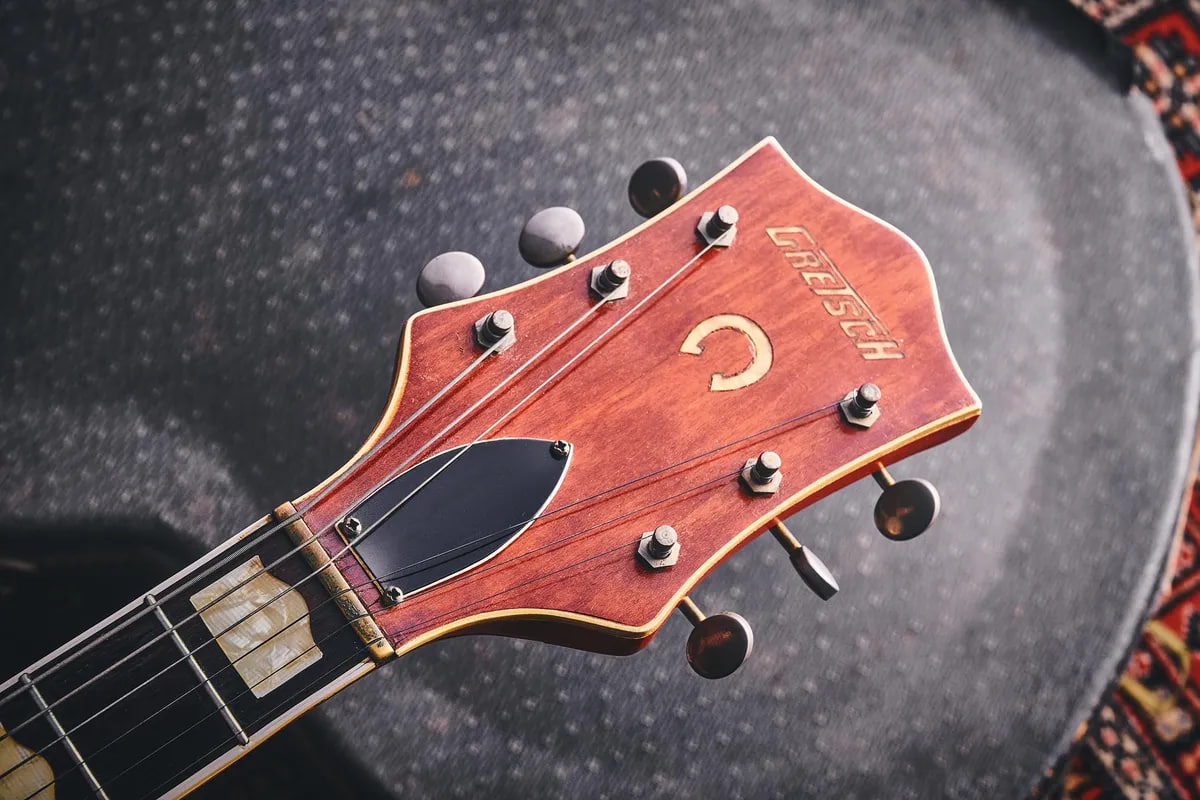
By 1957, Gtetsch was phasing out the Western look, largely at the urging of its top endorser, Chet Atkins. Gone were the steer-head inlays and cowboy motifs. The hump block markers and a more refined horseshoe headstock inlay replaced them, while the branded “G” on the body was discontinued.
Why Page wanted this specific 6120
In the early 1970s, Jimmy Page sought out a G-branded 6120 because Eddie Cochran had been a major inspiration. When Nashville’s GTR shop located one, Page paid just £200 — a bargain at a time when 1950s Les Paul models could cost $1500.
Information about vintage guitars was scarce back then, so Page’s descriptions were full of confusion. He even referred to the guitar as a “Chet Atkins Hollowbody,” unsure of its exact designation.
The giveaway that shocked fans
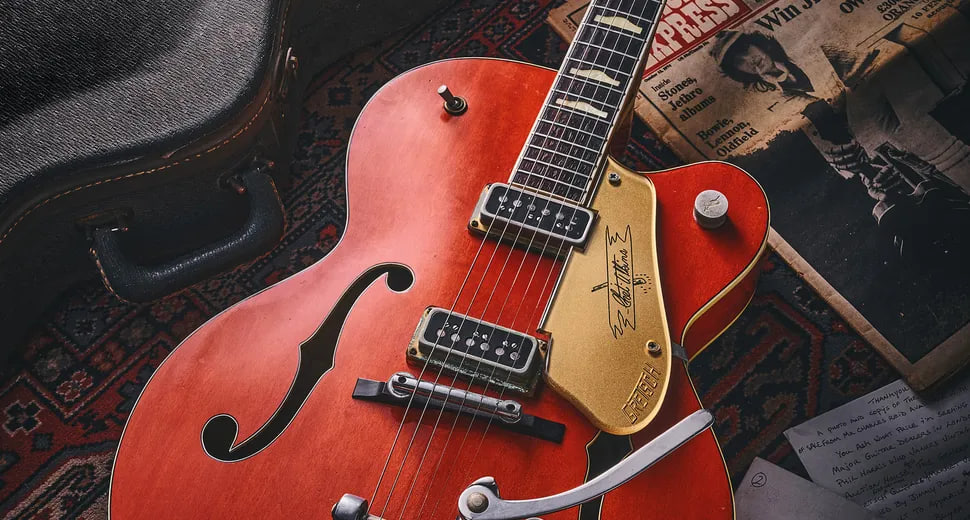
In 1974, Page surprisingly offered his 6120 as the top prize in an NME competition. The winner could also choose either £300 in Orange gear or ten new Gibson acoustics — but the Gtetsch was the crown jewel.
The contest winner, 21-year-old Charles Reid from Dublin, received the guitar directly from Page, posed for photos and used the instrument while auditioning for London bands. Little is known about his later career, but in 1990 he sold the guitar to Phil O’Donoghue for £2,000.
From private hands to the auction block
Following O’Donoghue’s passing, his brothers contacted Gardiner Houlgate to auction the guitar. Auctioneer Luke Hobbs was astonished: aside from oxidation around the pickups — caused by decaying celluloid spacers trapping gas inside the case — the guitar was in remarkable shape.
The finish remained vibrant, the neck needed no reset, and the action was low. Despite old strings, the guitar resonated beautifully.
How much is “Page’s 6120” really worth?
A clean mid-50s 6120 typically sells for £7,000–£10,000. A near-mint example may reach £10,000. But this one carried something extra — a fully documented link to Jimmy Page.
Its presale estimate was £30,000–£50,000.
The final hammer price?
£100,000 — roughly $135,000.
The original contest winner once joked:
“Page must be mental giving away such a terrific guitar!”
Looking at the auction result, he had a point.

