

“The CBS Era Revisited: Why Fender Guitars of the Late ’60s Didn’t Suddenly ‘Decline in Quality’ — And What Actually Changed”
Dec. 18, 2025, 9:15 a.m.
When CBS acquired Fender in 1965, many players today imagine an abrupt downfall — as if the company instantly abandoned its traditions and the instruments suddenly lost their legendary feel. But that narrative simply doesn’t match reality. The transition was gradual, controlled, and far less dramatic than popular lore suggests.
CBS viewed Fender as a booming brand at the heart of modern music. To expand production and improve profitability, the corporation refined manufacturing, adjusted materials, and optimized workflows. Most changes were subtle, often cosmetic, and introduced gradually between 1965 and 1970.
Let’s break down what truly changed — and what remained untouched — during the early CBS years, focusing on iconic models like the Stratocaster and Telecaster.

Necks: familiar feel, updated details, and smart improvements
Right after the acquisition, Stratocaster and Telecaster necks continued unchanged. Fender had stockpiles of pre-CBS necks ready to install, so naturally the company used them rather than throwing them away.
When the old supply ran out, CBS substituted scarce Brazilian rosewood with more available options like Indian rosewood and pau ferro. These woods often looked lighter, but the tonal difference was negligible.
One of the first practical upgrades CBS implemented was replacing aging “clay” position dots with durable, brighter celluloid markers. Offsets received binding in 1965, followed by block inlays in 1966.
Headstock logos also evolved. The small “spaghetti” design faded out by late 1964, replaced by transitional decals and, eventually, by the larger black Fender logo launched in 1967 — highly visible on telecaster

In 1968, CBS encountered problems with new fast-drying polyester finishes clashing with decals. The solution was to coat headstocks with nitrocellulose, giving them a darker appearance. In 1969, Fender returned to the classic one-piece maple neck design with a rear truss-rod route and walnut skunk stripe.
Bodies: weight myths, design tweaks, and hidden cavities
The idea that CBS drastically increased guitar weight in the 1960s is largely false — excessively heavy instruments became common only in the mid-1970s. In the 60s, weights varied widely, just as they had in earlier eras.
The Stratocaster stayed predominantly alder-bodied, while many Telecaster guitars retained ash. When the ash supply became too heavy, Fender began routing hidden lightening cavities beneath the pickguard in 1967. These became the famous “smuggler’s Telecasters.”
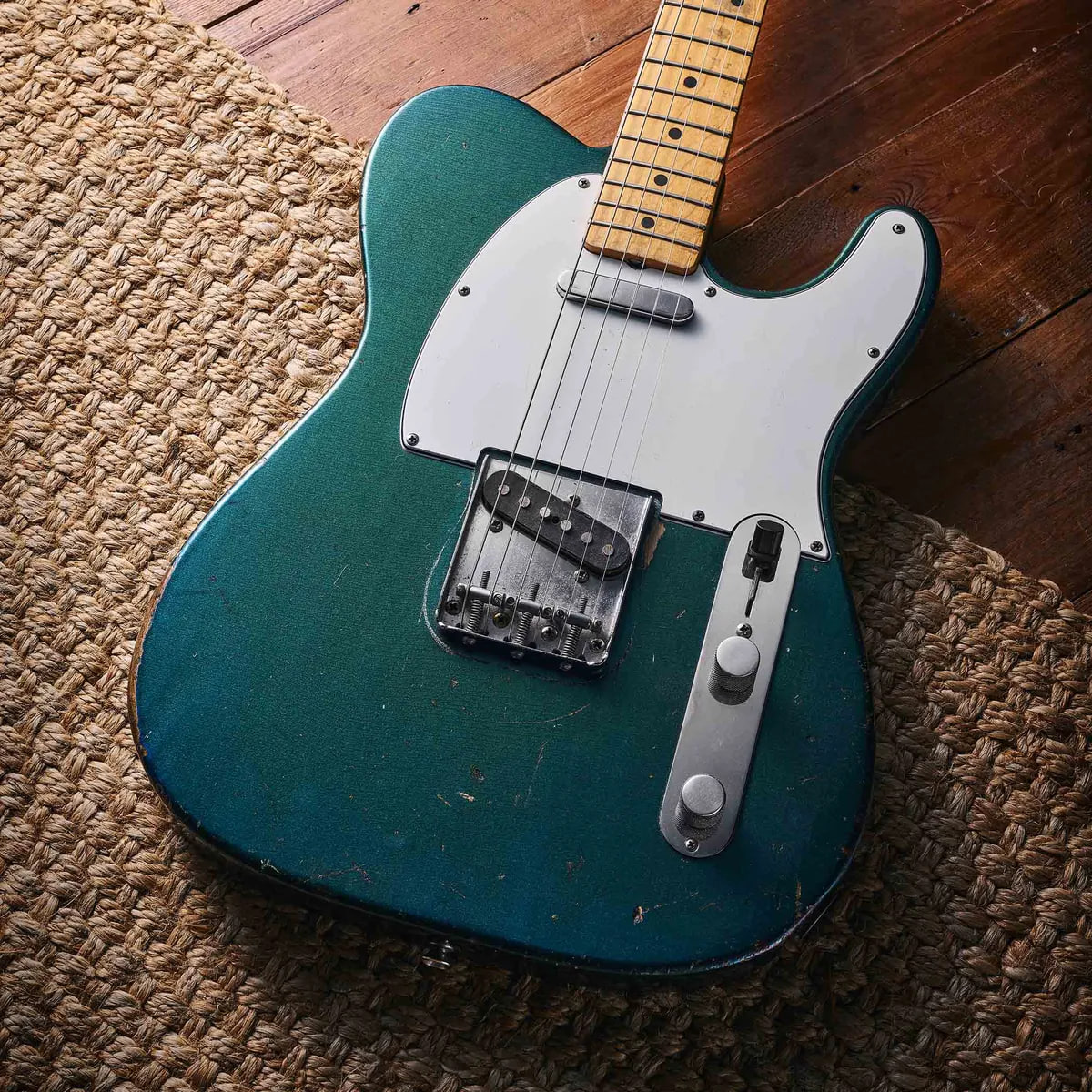
In mid-1969, wiring channels were revised to the earlier straight-drilled method. Stratocaster pickup cavities became more squared off to account for the thick new poly finish.
Electronics: brighter tone, clearer wiring, and era-defining tweaks
The Stratocaster’s wiring layout stayed unchanged, but its tone capacitor shifted from 0.1µF to 0.05µF in 1968, brightening the guitar’s voice. The shielding plate was removed that same year.
The Telecaster received its now-standard neck/middle/bridge switching in late 1967, with a treble bleed capacitor added to preserve highs as volume decreases.
CTS pots gradually replaced Stackpole beginning in 1965, and by 1969, 1M pots became standard on many Telecaster models.
Hardware & Plastics: modern materials with vintage character
When celluloid pickguards ran out, three-ply PVC/ABS guards became standard, with some Stratocaster models receiving striking four-ply tortoiseshell guards.
Kluson tuners gave way to CBS’s “F”-branded machines in 1967. The Telecaster received smoother saddles and redesigned knobs around 1968.

Pickups: from hand-scatter to automation — and a new tonal signature
Pickup tone depends heavily on winding style and materials. In the pre-CBS era, operators scatter-wound coils by hand, producing airy highs and dynamic response.
CBS standardized the use of plain enamel wire and transitioned to automated winding, yielding more consistent coils with fewer winds. This created lower resistance readings, slightly brighter tones, and a tighter midrange — the very sound heard on records by Hendrix and Gilmour.
By 1967, lacquer potting replaced wax, increasing microphonic sensitivity but contributing to the sharper tone of the era.

