

🎸 “He had a little saboteur in him”: Mark Knopfler on working with his childhood hero, Bob Dylan
Feb. 22, 2026, 9:15 a.m.
Mark Knopfler on His Complicated Collaboration with His Childhood Hero, Bob Dylan
The phrase “never meet your heroes” exists for a reason — and nowhere does it ring truer than in the creative arts. When artists live at a distance, they often occupy a near-mythical space in our minds. But once personal interaction begins, those idealized images can quickly give way to the very human, and sometimes difficult, realities behind the legend.
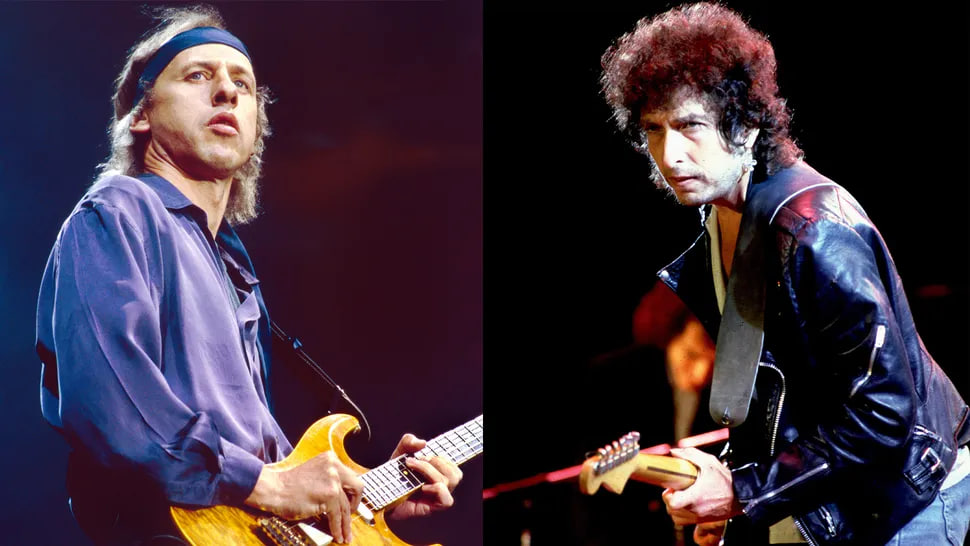
Producer Rick Rubin explores this idea in his book The Creative Act: A Way of Being, writing:
“Many great artists develop sensitive antennae not in order to create art, but to protect themselves. They must protect themselves because everything hurts more. They feel everything more deeply.”
Mark Knopfler learned this lesson firsthand in 1983, when he was invited to produce an album for his childhood idol, Bob Dylan. The project would become Infidels, a record that marked Dylan’s decisive return to secular songwriting after three albums shaped by his born-again Christian period.
From Slow Train Coming to the Height of Dire Straits
Before stepping into the producer’s chair, Knopfler had already crossed paths with Dylan musically. He played guitar on Slow Train Coming (1979), the first release in Dylan’s so-called “Christian trilogy.” That album arrived shortly after Knopfler’s own rapid ascent to international fame, sparked by Dire Straits’ 1978 self-titled debut and its defining hit, Sultans of Swing.
Reflecting on Dylan’s influence, Knopfler told Guitar Player magazine in 1984:
“I was hugely influenced by him when I was about fourteen or fifteen. I listened to Bob Dylan from the very beginning — the ‘Hard Rain’ era — and followed him all the way through. I’m still with him. I still think he’s great. Blood on the Tracks is one of my favorite records of all time.”
Those words carry particular weight given the intense and often frustrating experience Knopfler endured while working with Dylan just a year earlier.
Why Dylan Chose Knopfler
Before settling on Knopfler, Dylan reportedly considered David Bowie, Elvis Costello, and Frank Zappa as potential producers — and rejected them all. Feeling uneasy in modern studio environments, Dylan wanted someone comfortable with contemporary recording technology. The eclectic shortlist also suggests that he was searching for a dramatic shift in sound and creative direction.
However, when recording began at New York City’s Power Station in April 1983, Knopfler quickly realized that many of the key artistic decisions had already been made. Rather than steering the sessions, he found himself navigating them — guiding musicians through Dylan’s unpredictable moods and sudden changes of direction.
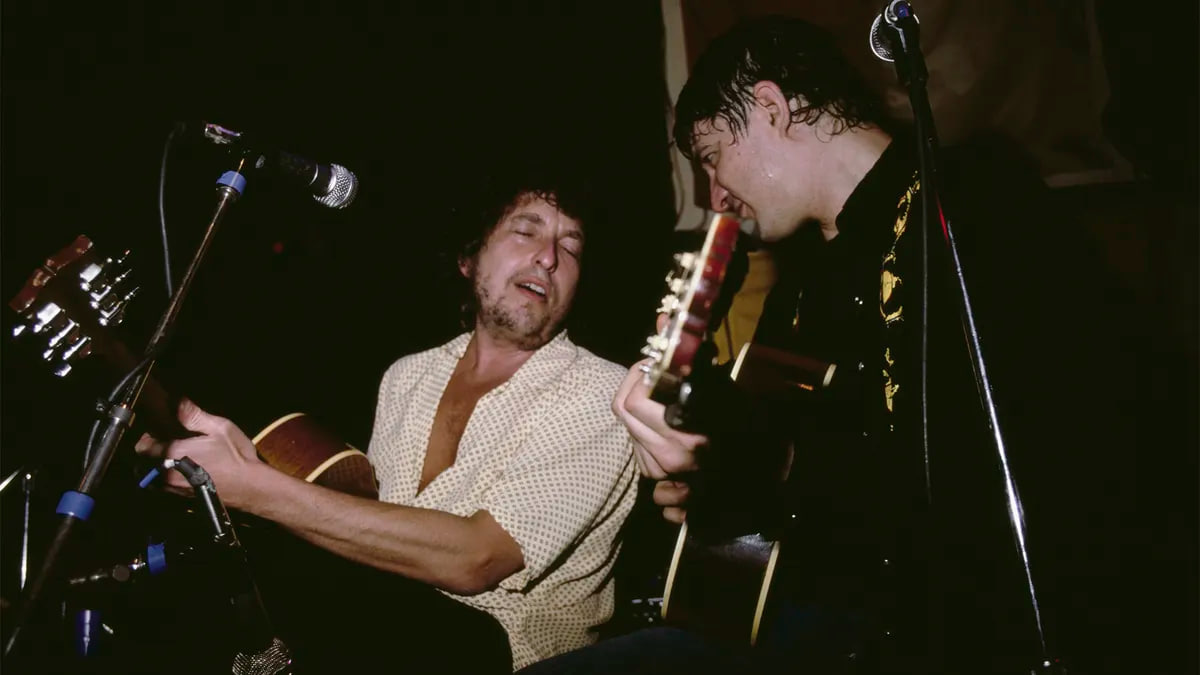
The Band That Defined Infidels
The album’s polished yet rhythmically charged sound was shaped by Dylan’s choice of musicians. For the rhythm section, he recruited bassist Robbie Shakespeare and drummer Sly Dunbar, the legendary duo known as Sly & Robbie. Already famous as producers and Island Records artists, they had worked with acts such as Black Uhuru, Wailing Souls, and Grace Jones.
On guitar, Dylan enlisted former Rolling Stones lead guitarist Mick Taylor, whom he had met the previous summer and begun sharing songs with months before recording started.
Knopfler, meanwhile, brought in keyboardist Alan Clark and engineer Neil Dorfsman, collaborators from Dire Straits’ Love Over Gold and the soundtrack to Local Hero. As both producer and musician, Knopfler shared guitar duties with Taylor, whose expressive slide work became a defining feature of the album.
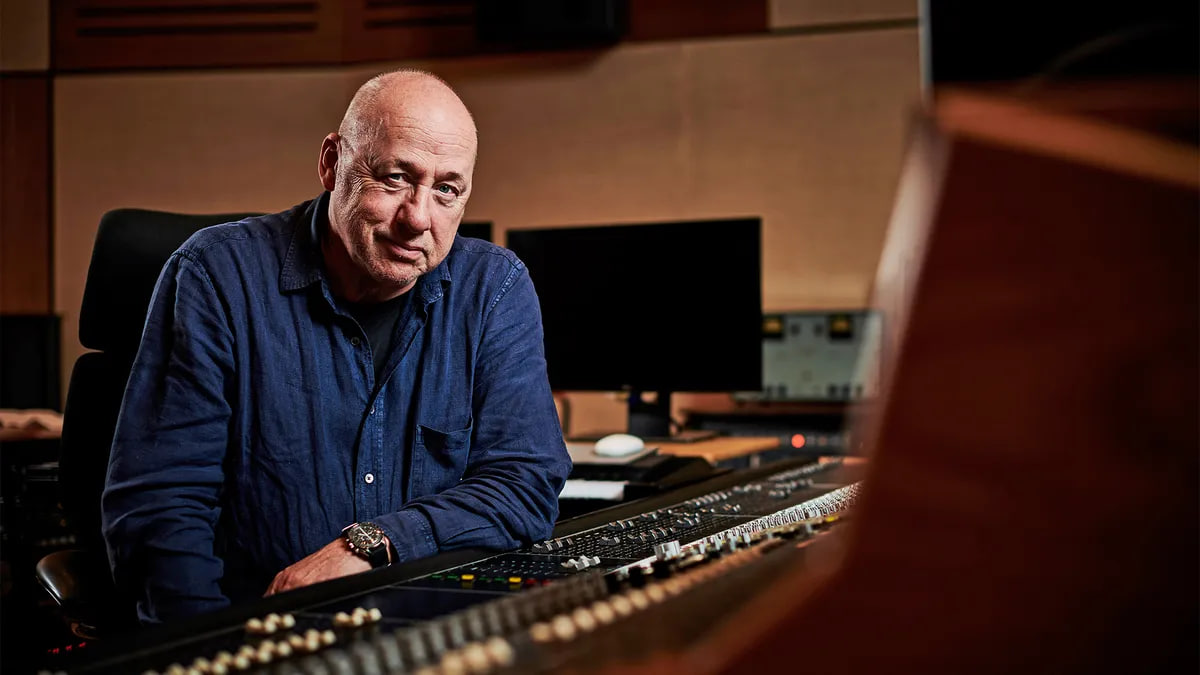
Two Guitar Voices, One Defining Album
The result was a record driven by two distinct yet complementary guitar styles. Knopfler’s fluid phrasing and Taylor’s lyrical slide playing blended seamlessly with the deeply syncopated grooves of Sly & Robbie. Many listeners now regard Infidels as one of Dylan’s strongest later-career albums.
Tracks such as License to Kill, Neighborhood Bully, Sweetheart Like You, and the haunting opener Jokerman showcased a confident stylistic evolution — one that successfully repositioned Dylan in the 1980s musical landscape.
“He Had a Little Saboteur in Him”
Despite the album’s success, the sessions themselves were anything but smooth. Engineer Neil Dorfsman later described Dylan’s behavior in vivid detail:
“I don’t want to use the wrong word, but Bob was a bit of an agent provocateur. He definitely had a little saboteur inside him. If things were going too well — at least by someone else’s definition — he would consciously try to disrupt that.”
During one session, Dylan took the foil wrapper from his lunch sandwich and began flexing it into the microphone. According to Dorfsman, it was simply his way of signaling boredom and a desire to move on.
On another occasion, Dylan suddenly announced that he wanted to abandon the current work and start recording a Christmas album immediately. At the time, everyone assumed he was joking — until, years later, he actually released one.
A Producer Without Traditional Control
As the person responsible for maintaining momentum, Knopfler found the experience increasingly frustrating. Dorfsman recalled sensing the moment when Knopfler realized that the conventional role of a producer would not apply.
Song choices shifted unexpectedly, arrangements changed without warning, and decisions were often dictated by Dylan’s instincts rather than any predefined plan. While Knopfler handled the situation with professionalism, it clearly tested his patience.
When asked directly whether producing Dylan was difficult, Knopfler responded with characteristic diplomacy:
“Yes, it was difficult at times. But you learn from seeing how different people work. You have to adapt. Every song has its own life and its own secret. There are no rules in songwriting or producing — you have to stay sensitive and flexible.”
Discipline, Genius, and Poetry
Knopfler went on to draw a thoughtful distinction between their approaches:
“I’d say I’m more disciplined. But Bob is far more disciplined as a lyricist — as a poet. He’s an absolute genius. As a singer, too. Musically, it’s more basic, but that music serves the poetry. And that’s the point.”
Despite everything, Knopfler remained deeply moved by Infidels, especially the song I and I. He once remarked that hearing its opening lines was enough to make any songwriter consider retirement.
Soul Above Technique
Reflecting on Dylan’s musicianship, Knopfler emphasized that technical ability is secondary to emotional truth:
“You don’t have to be a great technician. If something is played with soul, that’s what matters. Just listen to a Howlin’ Wolf record — that’s pure feeling.”
Legacy Beyond the Studio
The collaboration between Mark Knopfler and Bob Dylan was tense, unpredictable, and often exhausting — yet it produced a record that continues to resonate decades later. It stands as proof that creative friction, when paired with mutual respect, can result in something timeless.
For guitarists inspired by Fender, the expressive clarity of a Telecaster, or the lyrical phrasing often associated with a Stratocaster, this chapter of music history remains essential reading — and listening.

