

Uli Jon Roth (ex. Scorpions): “Too many guitarists sound like typewriters”
April 15, 2026, 9:15 a.m.
Uli Jon Roth: Why Chasing Technique Can Kill a Guitarist’s Identity

A legendary guitarist speaks out on modern playing trends
In a 2025 interview with North Coast Music Beat, recently uploaded to YouTube, iconic German guitarist Uli Jon Roth shared his thoughts on today’s generation of players and offered valuable advice on finding a unique musical voice.
Less imitation, more individuality
According to Uli Jon Roth, young guitarists should avoid over-listening to other players. While technical skill is important, placing too much focus on it can be limiting.
He pointed out that although there is an abundance of talent today, many musicians are overly focused on technical perfection, often at the expense of personal expression and individuality.
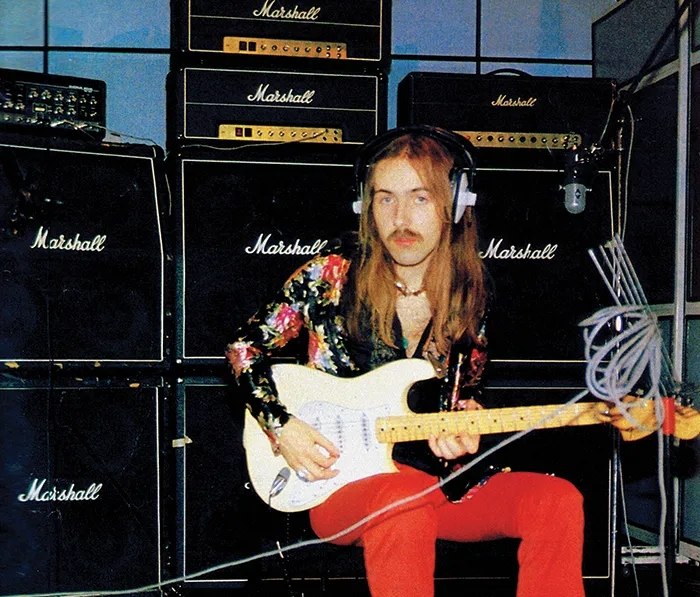
“Too many guitarists sound like typewriters”
Using a vivid metaphor, Uli Jon Roth described how many modern players sound mechanical — fast and precise, but lacking emotional depth. He made it clear that this is not meant as criticism, as there are many highly skilled musicians out there.
However, for those who want to stand out, his advice is simple:
play fewer notes, but make each one meaningful and expressive.
As he has matured, he has shifted his own focus away from speed toward musical substance. He compared it to speech — it’s not about how fast you talk, but about what you actually say. Rapid but empty communication is ultimately meaningless.
Finding your own voice: key advice
Uli Jon Roth encourages young musicians to:
— develop their own musical identity
— go beyond scales and arpeggios to understand harmony and rhythm
— connect deeply with music on an emotional level
— master their craft without losing individuality
He believes that true inspiration and deep understanding naturally lead to a distinctive style.
On metal music and the loss of dynamics
In another interview with the Scars And Guitars podcast, Uli Jon Roth discussed his relationship with heavy metal and his influence on the genre.
Despite his time with SCORPIONS, he does not consider himself a metal guitarist. Early in his career, the band was seen more as a melodic hard rock act, as the term “heavy metal” had not yet fully emerged.
He expressed that much of modern metal feels overly saturated and lacking in dynamics. In contrast, bands from the '60s and '70s like LED ZEPPELIN, Jimi Hendrix, and CREAM combined power with dynamic variation.
Today, he feels that constant distortion and maximum intensity often result in a wall of sound that lacks nuance. While he acknowledges there are excellent examples within the genre, it is not his personal preference.
Influence on rock guitar history
When asked about his impact alongside Michael Schenker, Uli Jon Roth downplayed the idea of being a central architect of rock guitar.
He emphasized that his generation built upon earlier legends such as Eric Clapton, Jimi Hendrix, and bands like LED ZEPPELIN, Rory Gallagher, and MOUNTAIN.
Still, the early 1970s were a time of exploration and innovation. He highlighted key pioneers including:
Jan Akkerman, Ritchie Blackmore, Brian May, David Gilmour, Allan Holdsworth, Gary Moore, Hank Marvin, George Harrison, Jimmy Page, and Jeff Beck.
He noted that the UK, in particular, became a hub for groundbreaking guitar players who shaped the future of rock music.
Legacy and innovation
In recent years, Uli Jon Roth has revisited his early work with SCORPIONS, resulting in releases such as Scorpions Revisited and Tokyo Tapes Revisited.
Widely regarded as one of the greatest guitarists of all time, he pioneered a distinctive style that blends technical mastery with deep melodic and emotional expression.
He was among the first to introduce complex arpeggio-based phrasing into rock guitar, effectively redefining modern guitar technique — especially during his time with SCORPIONS and later with ELECTRIC SUN.

