

Ted Aguilar: “Modern Metal Has an Identity Problem — Too Many Bands Sound the Same”
June 28, 2026, 9 a.m.
The Death Angel guitarist explains why today’s metal scene is overflowing with talent, yet often lacks the individuality that once defined the genre
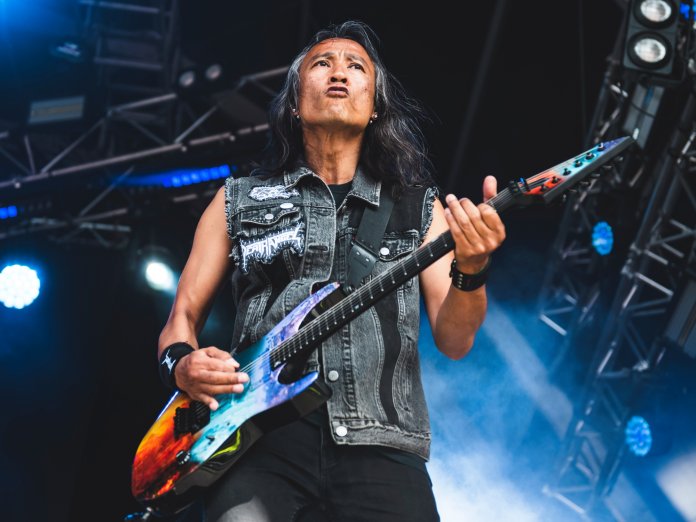
Death Angel guitarist Ted Aguilar believes that one of the biggest challenges facing modern metal is the loss of distinctive musical identity. While today’s players possess extraordinary technical abilities, he argues that many bands struggle to develop a unique sound that sets them apart from the crowd.
In a recent interview with Pipeman, Aguilar shared his thoughts on the evolution of metal and compared today’s scene with the classic era of thrash metal, when each band had its own unmistakable character.
According to Aguilar, his comments are not meant as criticism of contemporary metal bands. In fact, he praises the current scene for its vitality and the sheer number of musicians keeping the genre alive.
“I have nothing against today’s metal bands,” Aguilar explains. “One of the positive things is that there are so many of them. Maybe even too many at times. The scene is heavily saturated, but these bands are carrying the torch and ensuring that metal continues to thrive.”
Still, he believes that the abundance of bands has created a different issue.
“I grew up during a period when thrash metal offered a huge variety of sounds. Anthrax sounded completely different from Overkill. Death Angel had a different identity than Testament. Every band had its own personality and approach.”
The Thrash Era Was Defined by Unique Sounds
Aguilar emphasizes that bands from previous generations managed to maintain individuality despite operating within the same genre.
“Yes, they were all playing thrash metal. Of course, many of them were influenced by the New Wave Of British Heavy Metal movement, punk rock, and certainly Metallica. Practically everyone was influenced by Metallica and Exodus, because they were among the pioneers leading the movement.”
However, he says those bands never wanted to become copies of one another.
“They all wanted that same aggression and energy, but expressed it through their own style and personality.”
As an example, Aguilar points to several iconic vocalists from the thrash scene.
“Take Mark Osegueda from Death Angel. He sounds nothing like Chuck Billy from Testament. Chuck Billy doesn’t sound like Sean Killian of Vio-Lence, and none of them resemble Steve ‘Zetro’ Souza from Exodus.”
The Issue Isn’t Talent — Musicians Have Never Been Better
Aguilar makes it clear that his concerns have nothing to do with musicianship.
In fact, he believes the current generation possesses technical skills that often surpass those of earlier eras.
“My biggest issue with modern metal — and this is simply my personal opinion, not an attack on any band — is that I often can’t tell one band from another.”
He continues:
“There are incredible musicians playing metal today. Honestly, many of them could run circles around players from my generation. Their level of talent is astonishing.”
Bands Used to Grow Together
One of the major differences, according to Aguilar, is how musicians develop their skills.
In earlier decades, band members learned their instruments together and evolved as a collective unit.
“Back then, you figured things out as a band. You learned together, played cover songs together, and wrote original music together.”
Today, however, many musicians arrive fully developed before ever joining a group.
“There are amazing players out there, and again, this isn’t criticism. They’re unbelievable. Sometimes I wonder what’s in the water because these musicians are operating at such a high level.”
He believes online resources have fundamentally changed the learning process.
“With YouTube, social media, influencers, and countless educational platforms, musicians can reach an incredible level of proficiency entirely on their own.”
Technology Cannot Replace Human Interaction
Despite recognizing the advantages of modern technology, Aguilar believes there is no substitute for musicians sharing a room and creating music together.
“There’s something special about being in the same room, learning from one another, exchanging ideas, and building songs collectively.”
He suggests that many musicians who spend most of their time practicing alone may struggle to connect with other players in a band setting.
“When you become too accustomed to working by yourself, it can be difficult to develop that natural chemistry with another musician.”
The Organic Process Created Great Bands
Reflecting on the early days of thrash metal, Aguilar says the collaborative nature of songwriting was a key ingredient in developing a band’s identity.
“Back then everything felt organic. You got together, played, went home, practiced more, then came back with a new idea and worked on it as a team.”
That process, he believes, encouraged creativity and helped bands establish unique sounds that audiences could instantly recognize.
Modern Tools Are Useful — But They’re Not Everything
Aguilar acknowledges that technology has dramatically improved the way musicians can collaborate.
“Like everything in life, there are advantages and disadvantages.”
Today it is possible to record riffs at home, send them across the world in seconds, and even complete entire recording projects remotely.
“You can create a riff, send it to someone, have them learn it, and continue developing the song without ever meeting face-to-face.”
Yet he insists that personal interaction remains essential.
“You still need to get into a room together at some point. There’s a certain synergy that only happens when people interact directly.”
For Aguilar, music is about more than notes and technical skill.
“When you can see someone’s reaction, understand how they feel about an idea, hear their contributions, and even experience disagreements, that’s where real creativity happens.”
In his view, that human connection is exactly what helped classic thrash bands forge their own identities and create music that remains influential decades later.

