

🎸 “It sounded perfect… like a gift from on high”: Slash’s legendary Les Paul and a possible Gibson rebirth
March 11, 2026, 9:15 a.m.
Legendary Guns N’ Roses guitarist Slash has once again ignited global excitement around his most iconic instrument. What appeared to be a simple Instagram post quickly turned into major news, thanks to a telling comment from Gibson CEO Cesar Gueikian.
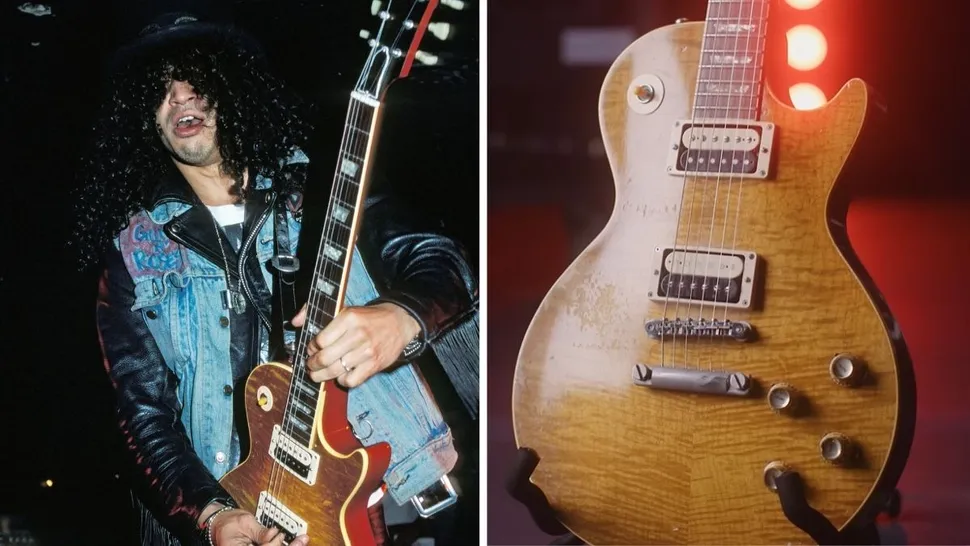
The image shows Slash’s number one Les Paul, built by master luthier Kris Derrig, resting on a workbench and prepared for precise 3D scanning. Notably, this famous electric guitar was never made by Gibson, despite becoming one of the most recognizable Les Paul-style instruments in history. Gueikian’s comment — “Epic! Let’s go…” — was enough to confirm what many had already suspected.
All signs point toward a high-end reissue, potentially as a Murphy Lab recreation, faithfully replicating every scratch, ding, and nuance that defines the original instrument’s character.
Slash purchased the Derrig ’59 Les Paul in 1987, and it immediately became his primary recording guitar. It was used extensively on Appetite for Destruction, the 18-times-platinum debut album by Guns N’ Roses, and on countless recordings that followed. Tragically, Kris Derrig passed away from cancer that same year and never witnessed the enormous legacy his creation would leave behind.
“That Derrig ’59 came in at the eleventh hour while we were recording Appetite,” Slash once recalled in Guitar World. “We had finished the basic tracks, but none of my guitars sounded right. I was seriously thinking, ‘What the hell am I going to do?’”
According to Slash, the band’s manager at the time, Alan Niven, brought the Les Paul to the studio just as guitar overdubs were about to begin. “It sounded perfect, man… like a gift from on high,” he said.
From 1987 into 1988, the guitar became his constant companion on the road as well. “In that short period of time, I absolutely beat the hell out of that guitar,” Slash admitted.
That history is exactly what makes the idea of a Murphy Lab recreation so compelling. If Gibson truly recreates the instrument down to every worn edge and battle scar, the price is expected to land far closer to $20,000 than the roughly $2,000 Slash originally paid for it.
While Gibson has released Derrig-inspired Les Paul models before—most notably the Custom Shop AFD edition in 2016—none have aimed to reproduce Slash’s personal guitar with this level of forensic detail.
If the speculation proves true, this upcoming release could become one of the most important signature guitar launches ever—an electric guitar that not only shaped legendary recordings but helped define the sound of modern rock itself.
One of the most fascinating aspects of Kris Derrig’s guitars is the historical context in which they were built. At the time, Gibson had not yet fully embraced the reissue movement, and vintage-accurate recreations were far from a mainstream focus. It was Slash, wielding this very guitar on the world’s biggest stages, who helped shift the industry’s perspective and reignite a global obsession with classic Les Paul design and tone.
Following those early tours—where the guitar was pushed to its absolute limits—Slash made the decision to retire it from live use. From that point forward, the iconic electric guitar became a studio-only instrument. Around the same period, he began developing a close relationship with Gibson and transitioned to playing official Les Paul models for touring and public appearances.
“I never actually met Kris,” Slash explained during an interview with Gibson TV last year. “He passed away before I ever got the guitar. But I own three of his instruments, and they are incredibly well built and technically precise—to the extent that he documented the details of an original ’59 Gibson down to the millimeter.”
He went on to highlight Derrig’s obsessive commitment to authenticity. “He made a point of sourcing original PAF humbuckers and installing them in his guitars. He had an extraordinary attention to detail,” Slash added.
As of now, it remains unclear whether this rumored project is still in its early stages or nearing completion. Gibson made no mention of it while outlining its ambitious plans for 2026 during NAMM, suggesting that patience may be required. Still, it has been a full decade since the last reissue, and with the original guitar believed to have been built in 1986, the timing feels perfect for a commemorative anniversary model.
So the question remains: is one of the most famous “knockoff” guitars in rock history finally about to receive the reissue it truly deserves? Let’s hope the answer is yes.

