

“Ozzy wanted a remote switch so he could shut it off from the next hotel room”
Jan. 13, 2026, 9:15 a.m.
How Randy Rhoads’ obsessive practice pushed Ozzy Osbourne to the limit — and inspired a tiny pedalboard that kept the peace
When Ozzy Osbourne recruited Randy Rhoads in late 1979, he instantly knew he had discovered something extraordinary. Rhoads was a rare virtuoso — a guitarist whose two-handed tapping, complex scale runs, and dramatic whammy-bar dive bombs injected Ozzy’s early solo albums with exactly the kind of explosive guitar firepower heavy metal demanded in the early 1980s.
But that brilliance came with a downside. Randy practiced constantly — on tour, after shows, late at night — and for Ozzy, the former Black Sabbath frontman who passed away on July 22, that relentless dedication could be maddening.
By early 1982, the final year of Rhoads’ life, a clever solution emerged. He was presented with a custom-built pedalboard designed exclusively for practice, created to satisfy both the endlessly practicing guitarist and his increasingly exhausted bandleader.
The pedalboard was built to Randy’s exact specifications by Jon Graves and Domenic Turlace of Zeus Audio Systems in Alhambra, California — a company known for producing guitar pedals and miniature amplifiers aimed at practice use. Rhoads received the unit on New Year’s Eve 1981, roughly two months into the tour supporting Ozzy’s second solo album, Diary of a Madman.
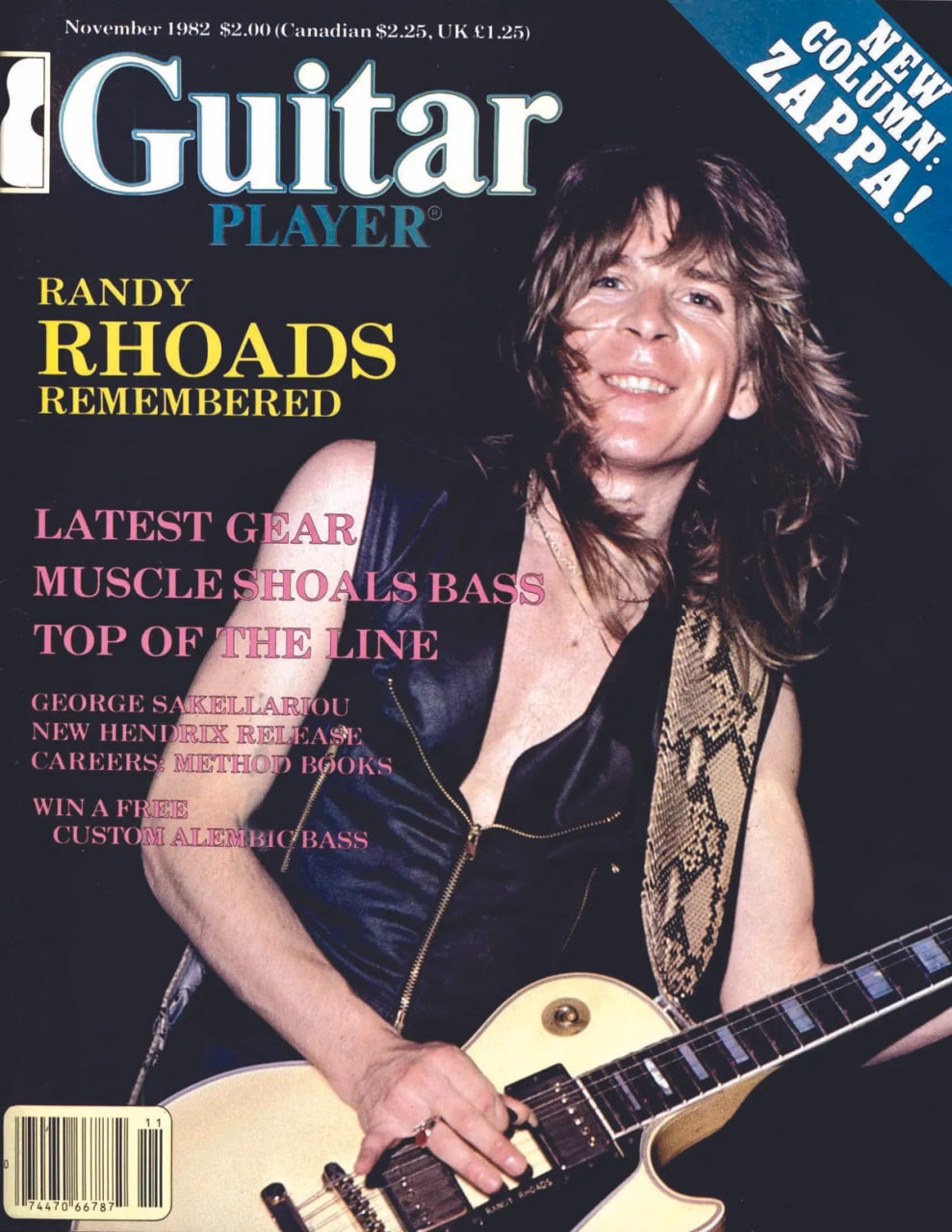
The image appeared in the magazine’s November 1982 tribute issue to Rhoads, spread across two pages. It showed Randy practicing on a couch beside three of his electric guitars: a 1974 Gibson Les Paul Custom, a Jackson Concorde, and a Karl Sandoval Custom Polka Dot Flying V.
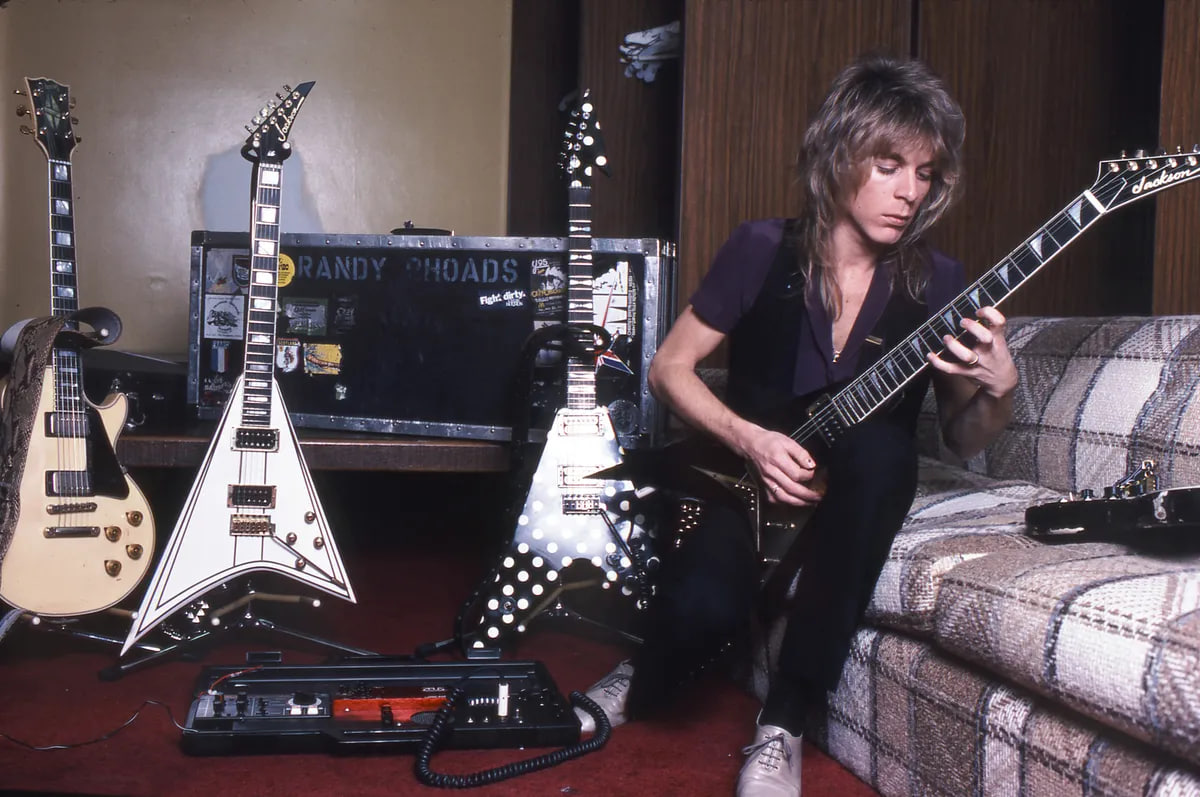
On the floor in front of him sat the compact pedalboard, its components partially obscured.
Two months after the photo appeared, Graves and Turlace provided a full description of the device in Guitar Player’s January 1983 issue, responding to a curious reader’s inquiry.
Despite its small footprint, the pedalboard was impressively equipped. It featured a Boss Dr. Rhythm drum machine, three MXR pedals — a 6-Band Graphic EQ, a Commande Time Delay, and a Micro Chorus — along with a Zeus 8401 Mini Amp.
The red-colored 8401, roughly the size of a brick, included controls for preamp, volume, and tone, as well as preamp and external speaker outputs. A second amplifier with a 4.5-inch speaker was supplied specifically for the drum machine.
However, the most notable feature was added purely for Ozzy’s peace of mind.
“One unique feature is the ‘Ozzy Jacks,’ added at Ozzy Osbourne’s request,” Turlace explained. “These jacks send separate signals from the guitar amp and rhythm machine to a headphone mix, while completely shutting off the main speaker.”
According to Graves, Ozzy had also requested a remote switch that would allow him to turn the pedalboard off from the next hotel room while on tour — a practical idea, given Randy’s tendency to play into the early morning hours. Though likely half-joking, the feature was never implemented.
The entire system was housed in an ABS plastic case salvaged from a Casio keyboard — arguably the most inspired use of a Casio ever. The lid contained both a battery pack and an AC adapter, and the pedalboard was designed so that closing the lid automatically cut the power.
As a finishing touch, the unit featured a gold-plated plaque reading:
“Custom made by Zeus Audio Systems for Randy Rhoads”,
along with a Rolls-Royce–style logo bearing two R’s.
In their response to readers, the builders made one thing clear: they had no intention of recreating the design.
“Anyone wishing to duplicate the pedalboard,” they stated, “will have to build one themselves.”
Tragically, Randy Rhoads had little time to enjoy the device. On March 19, 1982, he was killed when a small plane crashed during a tour stop in Leesburg, Florida — cutting short the life of one of rock’s most influential guitarists.

