

From Wood to Perfection: How a PRS Guitar Neck Is Crafted
July 20, 2026, 9 a.m.
The neck is one of the most critical components of any electric guitar. It is the part of the instrument that connects the player to the music, translating every movement of the fingers into sound. Anyone who has ever played a PRS Guitars instrument has likely noticed how naturally and comfortably its neck feels in the hand. That level of playability is no coincidence—it is the result of an intricate manufacturing process that combines advanced technology with the craftsmanship of highly experienced builders.
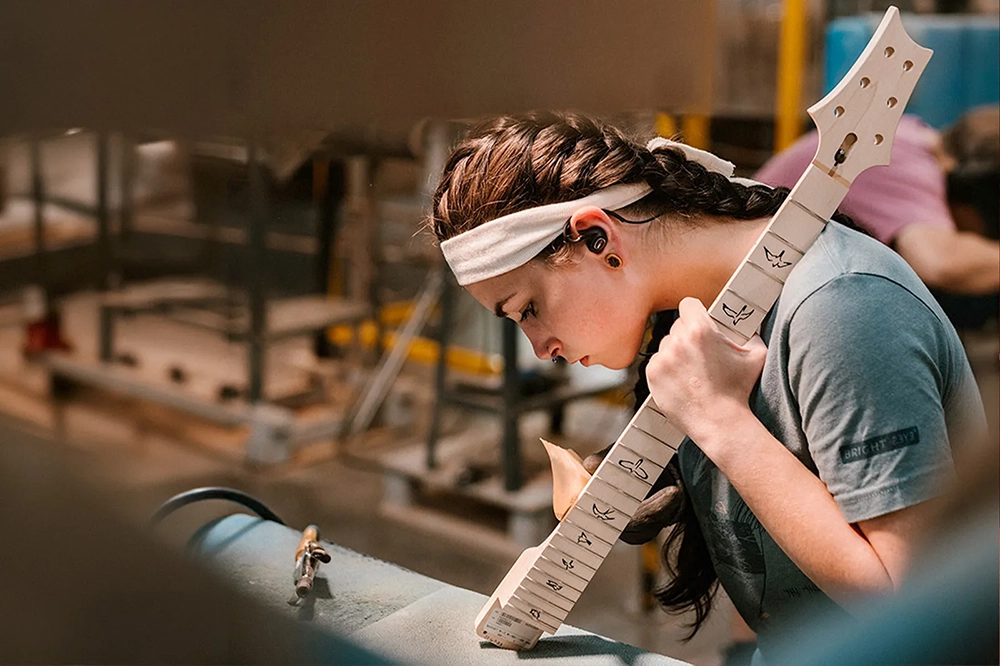
In this article, we'll take you inside the PRS Guitars factory to explore every stage of neck production, following the journey from a simple block of wood to a finely crafted component ready to become part of a world-class guitar. Our guide is Ryan Whaley, Second Shift Woodshop Manager at PRS Guitars, who walks us through each step involved in creating the company's renowned guitar necks.
The First Steps: Preparing the Wood and Creating Neck Blanks
Every neck begins its life in the rough-cut department, where carefully selected shipments of wood arrive at the factory.
Large boards are first cut into oversized neck blanks that will eventually become the foundation of every PRS neck.
However, cutting the wood is only the beginning.
Each blank is transferred to a heated drying room, where it remains for several days under carefully controlled conditions. The purpose of this process is to remove excess moisture and stabilize the wood before machining begins.
This stage is essential to the long-term reliability of the instrument. Properly stabilized wood is far less likely to shift, warp, or change shape over time due to variations in temperature or humidity, helping every neck maintain its structural integrity for years of use.
Once the drying process is complete, the neck blanks are ready for the next phase of production.
Before they are introduced to the Computer Numerical Control (CNC) machines, each blank undergoes careful preparation by hand.
An experienced PRS Guitars craftsman named Herman, who has spent many years working with the company, performs one of the most important preparation steps.
He carefully marks every neck blank to indicate where relief cuts will be made for the future "ears" of the headstock—the additional pieces of wood that extend the width of the headstock.
This operation demands exceptional precision.
Herman doesn't simply mark cutting lines. He carefully evaluates the grain direction, wood figure, and color of every piece to ensure that the headstock extensions will blend seamlessly with the rest of the neck. This meticulous attention to detail allows the finished neck to appear as though it has been carved from a single piece of wood, creating the clean, elegant appearance for which PRS Guitars is well known.
After the layout work is completed, each neck blank is carefully organized, stacked, and labeled before moving to the next stage of production.
Only then are the prepared blanks ready for the precision work of the CNC machines, where modern manufacturing technology begins transforming raw wood into the unmistakable shape of a PRS guitar neck.
Precision Engineering: CNC Machining and Truss Rod Installation
Once the preliminary preparation is complete, the neck blanks move to their first stage of Computer Numerical Control (CNC) machining. This is where an ordinary block of wood begins its transformation into a genuine PRS Guitars neck.
The CNC equipment performs several highly precise operations during this stage. First, the top surface of each blank is perfectly leveled, creating an accurate foundation for every process that follows. Next, the machine cuts the truss rod channel before beginning to shape the basic contours of the headstock.
With every machining cycle, the neck blank takes on more of the recognizable profile associated with PRS instruments. Although the equipment operates with remarkable precision, every step is closely monitored by experienced factory personnel to ensure that each neck meets the company's exacting standards.
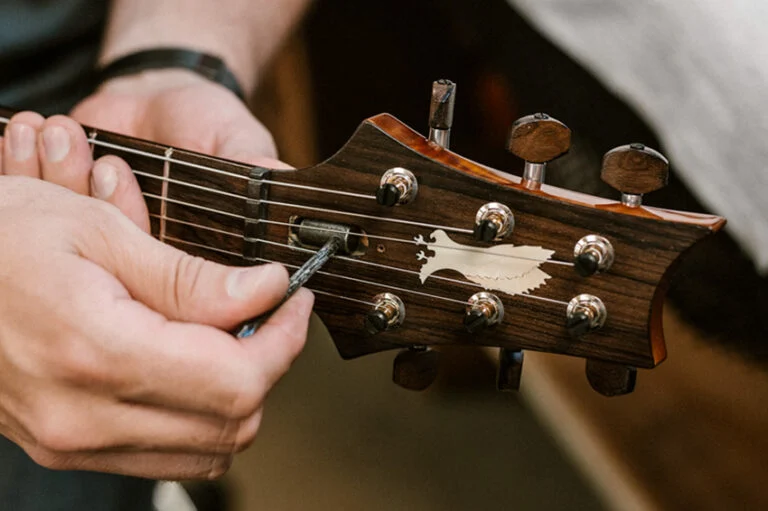
Once the truss rod channel has been machined, the next critical stage begins—the installation of the truss rod itself.
The truss rod is one of the most important structural components inside the neck. It allows the neck's curvature to be adjusted, compensating for string tension and helping maintain the correct geometry for comfortable action and consistent playability under changing environmental conditions.
At this point, another experienced member of the PRS Guitars team, Brian, takes over.
Before installing a truss rod, Brian carefully inspects every channel. His job is to ensure that the routed cavity is completely clean and free from wood dust, chips, or any other debris.
Even the smallest imperfection could affect how securely the truss rod sits inside the neck, potentially influencing its long-term performance. That is why every neck receives an individual inspection before assembly continues.
Only after confirming that the channel is perfectly clean and meets PRS Guitars quality standards does Brian install the truss rod into the neck.
Once the rod is in place, the assembly is transferred to a specialized press. Controlled pressure secures the truss rod firmly within the neck, ensuring a precise fit and preventing any movement during the guitar's lifetime.
The necks are then set aside to cure for several hours while the adhesive fully hardens. This curing period allows every component to become a stable, unified structure before additional manufacturing steps begin.
Although this stage may appear relatively straightforward, it plays a major role in determining the long-term reliability of the finished instrument. At PRS Guitars, consistency is achieved not through a single dramatic manufacturing step, but through dozens of carefully controlled procedures, each performed with uncompromising attention to detail.
For that reason, once the truss rod has been installed and the curing process is complete, every neck is inspected once again before moving on to the next phase of production.
Shaping the Headstock and Attaching the Fingerboard
After the truss rods have been securely installed and the adhesive has fully cured, the necks advance to the next important stage of production.
The first task is attaching the headstock "ears"—the additional pieces of wood that extend the width of the headstock and allow it to achieve the distinctive shape found on PRS Guitars instruments.
Although these components are relatively small, fitting them correctly requires exceptional precision.
Each ear is individually selected to match the neck blank as closely as possible. Grain orientation, wood figure, and color are carefully compared to ensure a seamless transition between the original neck and the added pieces. Once the guitar is finished, the joints are virtually invisible, giving the appearance that the entire neck has been carved from a single piece of timber.
After the matching process is complete, the ears are glued into position and secured by hand using specialized clamps. The necks remain under pressure overnight, allowing the adhesive to cure completely and creating an exceptionally strong bond.
Once the glue has fully hardened, the necks return to the CNC department for another round of precision machining.
During this stage, the machines further refine the shape of the headstock, giving it the familiar PRS profile. They also drill the tuner holes with extreme accuracy, ensuring that every tuning machine will be perfectly aligned during final assembly.
The machining process then moves to the back of the neck. Layer by layer, excess material is removed as the neck gradually approaches its finished dimensions. At this point, the overall profile has become clearly recognizable, although additional refinement still lies ahead.
Fingerboard Installation and Final CNC Carving
The next major operation is attaching the fingerboard.
Before any adhesive is applied, technicians at PRS Guitars perform a complete dry fit. The fingerboard is temporarily positioned on the neck to verify that every dimension, alignment point, and contact surface fits together flawlessly.
Only after this inspection confirms a perfect fit does the permanent assembly begin.
A specially formulated two-part epoxy adhesive is then applied between the neck and the fingerboard. This high-strength adhesive creates an exceptionally durable bond while eliminating even microscopic gaps between the two components, ensuring long-term structural stability.
After the adhesive is applied, the fingerboard is carefully positioned and the entire assembly is placed into a press. Constant pressure is maintained until the epoxy has completely cured, allowing the neck and fingerboard to become a single, rigid unit.
With the adhesive fully hardened, the neck returns to the CNC machines for its final stage of mechanical shaping.
This is where the signature PRS neck profile truly comes to life.
The CNC equipment precisely carves the contours of the back of the neck, shapes the heel, completes the headstock geometry, and verifies that every dimension matches the exact specifications established by PRS Guitars.
Even after this highly accurate machining process is complete, the neck is still not ready for finishing.
Instead, it is set aside for several more days. This waiting period allows the wood to fully stabilize after the machining process. If the material experiences even the slightest natural movement, it will occur during this stage, allowing technicians to identify and correct any minor changes before final finishing begins.
This extra time reflects one of the core manufacturing philosophies at PRS Guitars. Rather than rushing production, the company allows the wood to settle naturally, ensuring that every neck delivers the stability, durability, and playing comfort that musicians have come to expect from a PRS instrument.

The Finishing Stage: Sanding, Fret Installation, and Headstock Veneer
After spending several days stabilizing, the necks move on to the finishing department, where precision craftsmanship becomes just as important as advanced machinery.
Although the CNC machines have already produced an extremely accurate shape, the neck is still not considered complete. The next steps rely heavily on the experience and skill of the craftsmen who carefully refine every surface by hand.
The first operation is meticulous hand sanding.
Every neck is carefully sanded to eliminate even the slightest imperfections left after machining while refining its contours to achieve the smooth, comfortable feel for which PRS Guitars is renowned.
Throughout this process, craftsmen continuously inspect the neck by both sight and touch. Their goal is not only to create a flawless surface but also to ensure that every curve and transition feels completely natural in the player's hand.
This careful hand-finishing is one of the defining characteristics of a PRS neck, contributing significantly to the exceptional comfort and playability that musicians experience.
Once sanding has been completed, attention turns to the fret installation.
Each individual fret is installed separately. Before pressing it into the fingerboard, adhesive is applied to ensure a secure, long-lasting fit. Every fret is then carefully pressed into its slot using specialized equipment.
Accuracy during this stage is absolutely essential.
Every fret must sit perfectly level and be fully seated along its entire length. Even the slightest inconsistency could lead to fret buzz, poor intonation, or uneven playability. For that reason, each fret is carefully inspected as it is installed, with any necessary corrections made immediately before work continues.
After the complete fret set has been installed, the focus shifts to the headstock.
The next operation involves applying the decorative headstock veneer.
This thin wooden overlay serves both structural and cosmetic purposes. In addition to reinforcing the front of the headstock, it gives the instrument the elegant appearance that has become one of the signature design elements of PRS Guitars.
As with every previous production stage, this procedure is performed with exceptional care.
The veneer is precisely aligned with the headstock before being glued into position and secured with clamps. Technicians carefully verify that the veneer sits perfectly flat, with no gaps or misalignment anywhere along the bonding surface.
Once the adhesive has completely cured, the finishing work begins.
Any excess material is carefully trimmed away, the edges of the veneer are precisely shaped, and every trace of excess glue is removed. The result is a clean, flawless headstock that is fully prepared for the final stage of production—quality control.
Every operation performed during this phase depends on the combination of skilled craftsmanship and years of practical experience. It is this balance between advanced manufacturing technology and meticulous handwork that enables PRS Guitars to produce necks recognized worldwide for their comfort, durability, and exceptional level of craftsmanship.
Quality Control: Ensuring Every PRS Neck Meets the Highest Standards
Once every major manufacturing stage has been completed, the necks are transferred to the Quality Control department. Although inspections take place throughout the entire production process, this final evaluation is the last opportunity to confirm that each neck fully meets the demanding standards established by PRS Guitars before it is joined to a guitar body.
At PRS Guitars, quality is never left to a single inspection. Instead, every neck is examined repeatedly as it moves through production. The final Quality Control stage serves as the ultimate confirmation that every detail has been executed to perfection.
One of the specialists responsible for this process is David, an experienced member of the QC team.
Working methodically, David inspects every neck from end to end. Nothing is overlooked. He carefully checks the headstock veneer, verifies that every fret has been properly seated, examines the quality of the sanding, confirms the neck's geometry, and ensures the entire component meets the company's exact specifications.
If even the smallest imperfection is discovered—whether it's a slight inconsistency in the sanding, a fret requiring a final adjustment, or another minor detail—it is corrected immediately. Only after every issue has been resolved does the neck undergo one final inspection.
Once the neck successfully passes this comprehensive evaluation, it receives its final approval and moves on to the next stage of production, where it will be fitted to the body of a PRS Guitars instrument.
PRS Factory Tour with Ladkor (Part 1)
PRS Factory Tour with Ladkor (Part 2)
PRS Factory Tour with Ladkor (Part 3)
From a Block of Wood to a World-Class Guitar Neck
Building a PRS Guitars neck is a meticulous process that combines cutting-edge manufacturing technology with the experience and craftsmanship of highly skilled luthiers.
From the initial rough cutting of carefully selected wood and its stabilization, through precision CNC machining, truss rod installation, fingerboard bonding, sanding, fret installation, and multiple quality inspections, every stage is carried out with extraordinary attention to detail.
This uncompromising approach allows PRS Guitars to produce necks that are not only visually beautiful but also deliver the exceptional comfort, stability, and playability that have made the brand respected by musicians around the world.
Behind each guitar stands the work of dedicated engineers, experienced craftsmen, and quality control specialists, all working together to transform carefully selected wood into a professional musical instrument.
Whether you have been a longtime fan of PRS or are discovering the brand for the first time, a finely crafted neck is something you'll notice the moment you pick up the guitar. It is one of the defining features that continues to set PRS Guitars apart and one of the many reasons musicians worldwide trust the brand for its outstanding quality, reliability, and exceptional playing experience.

