

Elevating the Legend: How Simon McBride Redefined Deep Purple's Iconic Guitar Sound
Aug. 18, 2026, 9 a.m.
Stepping onto a stage once commanded by irreplaceable visionaries like Ritchie Blackmore and Steve Morse could easily paralyze any guitar player with stage fright. Yet, when Simon McBride officially assumed the guitar throne for Deep Purple, he leaped into the opportunity without a single hesitation. And make no mistake — he is fully prepared to deliver the legendary "Smoke on the Water" guitar lines entirely on his own terms.
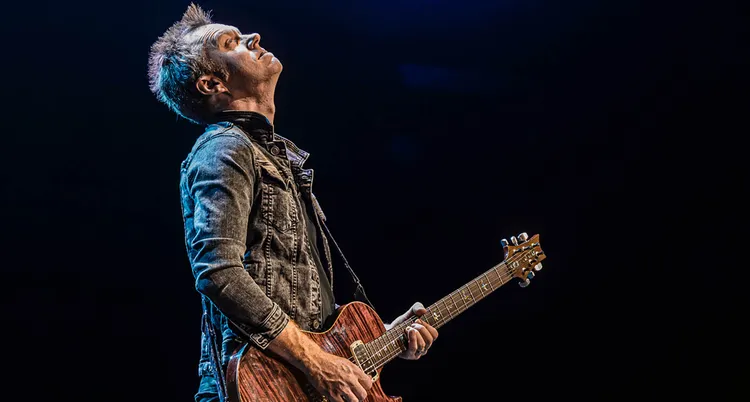
It is safe to say that Simon McBride is currently experiencing the absolute pinnacle of a musician's aspirations. Looking back at his childhood, he recalls that the rock world was ruled by three towering entities: Led Zeppelin, Black Sabbath, and Deep Purple. If anyone had approached his thirteen-year-old self to predict that he would eventually become an official member of Deep Purple, he would have dismissed it as a complete joke. Yet, three decades later, that impossible fantasy has transformed into his daily reality.
The Irish guitar virtuoso explains with a smile that he feels incredibly honored and fortunate. Joining a hall-of-fame rock outfit is the ultimate milestone for nearly every guitar enthusiast on earth, and he is currently living out that exact scenario, appreciating every single moment. To have his own musical identity linked with such a massive historic legacy feels completely mind-blowing.
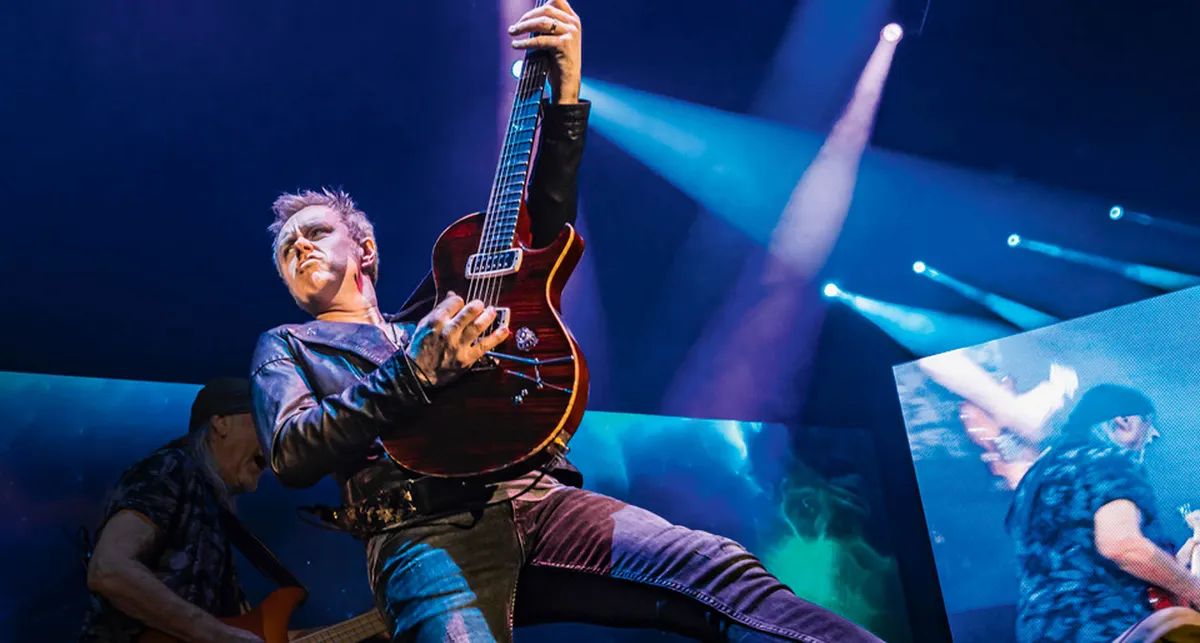
Naturally, taking over the guitar duties in 2022 meant filling some of the biggest shoes in rock history. He was stepping into the shoes of Steve Morse, an incredibly influential master of alternate picking and the longest-serving guitarist in the band's history. Furthermore, taking these tracks to live concert stages presented an even more immense challenge: recreating defining hits from the 1970s golden era, such as "Highway Star", "Black Night", and the monumental "Smoke On The Water". Every single one of those tracks carries the permanent, iconic signature of Ritchie Blackmore, one of the most celebrated guitar heroes of all time.
Fortunately, Simon McBride possessed decades of professional stage experience, including prominent collaborations with individual band members like vocalist Ian Gillan and keyboard wizard Don Airey. Armed with his dependable PRS electric guitars, he was fully prepared to face the challenge. Now, after two years of touring, he is celebrating the arrival of his very first studio album with the legendary band.
The brand-new record, titled "=1", marks the 23rd studio effort in the extensive history of Deep Purple. Interestingly, the entire writing and recording cycle proved to be completely seamless and free of anxiety for the newest addition to the lineup.
The guitarist shares that he did not feel the need to undergo any intense mental preparation for the sessions. He was always aware that a new studio record was on the horizon, and the sheer thought of writing an original album alongside Deep Purple was incredibly thrilling. Crucially, there was zero creative pressure from the veteran members regarding what direction the music should take. The musicians simply gathered in a room together. From his own viewpoint, the entire process felt effortless, allowing him to dive right into the music and play from the heart.
When you occupy a position previously defined by masters like Blackmore and Morse, how much does that historical weight occupy your thoughts?
Simon McBride firmly believes that the golden rule is to remain authentic to yourself. If a musician gets caught up analyzing what came before them — no matter the musical scenario — it will ultimately paralyze their creative output. Trying to go head-to-head with the likes of Steve Morse or Ritchie Blackmore is completely pointless because no one can execute their classic parts better than they did. The guitarist freely admits this and rejects any attempts to merely copy their historical performances.
He points out that the other members of the band specifically value his unique playing personality and independent approach. While he maintains immense reverence for the classic catalog — acknowledging that the exact parts written by Ritchie and Steve are essential structural elements of the songs that should never be altered — the writing sessions for the new album allowed for a fresh blend of diverse styles from every single individual in the room. That open-minded approach, free of rigid constraints, is precisely what has always drawn him to the music of Deep Purple.
Crafting an original song requires just as much dedication as mastering the physical mechanics of the guitar fretboard. However, continuously absorbing knowledge from other players is the best way to grow. Studying the foundational work of Ritchie Blackmore frequently opened his eyes to unexpected phrasing choices that he now confidently integrates into his own musical vocabulary.
Similarly, the material written by Steve Morse leaned heavily into a progressive rock territory. While progressive complex lines are not typically his preferred style, Simon found great value in deconstructing them. By analyzing the specific scales, modes, and technical shifts Steve utilized, he managed to learn from them and adapt those concepts. Operating like a musical sponge, he absorbs elements from various masters and reinterprets them through his personal lens.
When it comes to his core guitar tones, Simon McBride reveals that his studio recording setup is identical to his live touring rig, relying heavily on Engl amplification. Having spent his formative years listening to definitive classic and hard rock records, that specific sonic profile is permanently wired into his brain, regardless of what amplifier he hooks up to. If he happens to plug his guitar into a Fender amplifier, his hands and ears will still naturally try to extract a roaring Marshall style crunch, and the exact same principle applies when using a Vox.
As for his effects pedalboard configuration in the studio, he occasionally introduces a DigiTech Whammy for specialized sounds. However, the vast majority of the tracking relies on his primary Engl amplifiers, a classic Vox AC30 combo for specific multi-tracked guitar overdubs, and his preferred PRS guitars, which remain his constant choice. He frequently relies on two custom single-cut instruments (the 408 model) that the builders at PRS created specifically for him, noting their exceptional sonic flexibility. Additionally, he utilizes a Quad Cortex modeler, which proves incredibly efficient for capturing quick, high-quality takes during digital tracking sessions.
The guitarist's strategy for tracking guitar solos generally splits into two distinct paths. Roughly half of the guitar solos featured on the new album were successfully captured on the very first take. He would step up, improvise a line, and the track would be finalized. Legendary producer Bob Ezrin typically prefers to capture two or three alternative conceptual takes to provide flexible options during the final mixing stage. However, there were moments where Simon confidently insisted that he would not be able to outdo the raw energy of the initial take. As a result, the album features highly spontaneous, improvised leads alongside more structured, melodic arrangements, such as the harmonized multi-guitar melodies heard on the track "Pictures Of You".
The art of inventing memorable guitar riffs follows its own unpredictable patterns. The guitarist finds that trying to sit down intentionally to force a heavy riff into existence almost never yields results. A player can spend hours overthinking and noodling on the fretboard only to produce uninspiring ideas. Instead, the most compelling and memorable riffs consistently emerge when he clears his mind, stops overanalyzing, and just starts playing the moment the amplifier turns on.
Even an artist of his caliber encounters creative roadblocks from time to time. Whenever he finds himself stuck in a repetitive musical rut, his preferred solution is to actively pursue an entirely unfamiliar direction. He also continually expands his technical knowledge by studying advanced concepts like modal theory. Even though he possesses an extensive understanding of music theory, he notes that the subject is infinite, meaning there is always a new concept to explore. Experimenting with unfamiliar fretboard shapes or shifting a musical phrase an octave higher or lower frequently forces a guitarist to think outside the box. Even if the initial attempts sound strange, it remains an indispensable phase of the creative cycle.
Has his core playing style undergone a major transformation since joining the ranks of Deep Purple? From a purely mechanical standpoint, the answer is no, as navigating the technical requirements did not present an issue. However, the stylistic approach of Steve Morse is vastly different from the early path forged by Ritchie Blackmore. Due to a persistent wrist issue, Steve had to alter his playing approach compared to his high-velocity era with the Dixie Dregs — Simon jokingly notes that if he were forced to perfectly replicate those specific lines, he would probably throw in the towel.
Concurrently, the material established by Ritchie demands absolute precision in certain areas; the iconic lead on "Highway Star" is something he chooses to leave completely untouched. When you are standing on a stage looking out at 65,000 passionate rock fans singing back every single note of a guitar solo in perfect unison, you feel immensely grateful that you kept the original composition intact. Conversely, on a track like "Smoke On The Water", he felt comfortable reconstructing the solo sections to introduce his personal touch and modern phrasing.
In terms of discovering exciting new effects pedals, Simon highlights a recent addition to his live performance setup. Because of his extensive effects routing, he finds himself constantly stomping on switches during a live show. The most unusual tool on his current board is a Boss pedal known as the Slicer [SL-2], an effect that generates rhythmic, chaotic audio patterns. While some musicians find its unpredictable nature difficult to control, he embraces it to inject experimental, high-energy noise textures into performances of "Black Night", creating an intense sonic battle with his modulation pedals.
While Steve Morse frequently favored a complex Wet/Dry amplification setup during his touring years with the band, Simon McBride has recently adopted a similar routing philosophy. Although he historically relied on a traditional true stereo rig, transitioning to a dedicated Wet/Dry system has unlocked a much wider array of spatial and tonal options on stage. His expansive pedalboard features premium boutique choices, including the analog Analog WaterFall chorus from JAM pedals, alongside timeless performance standards like a vintage MXR Phase 90 and an MXR Octavia. Whenever gear enthusiasts question whether he actually utilizes such a massive array of effects, his response is always a definitive yes. Every single device on his board serves a distinct purpose, even if it only colors the mix for a brief couple of measures. It consistently injects fresh tonal textures into the show, keeps the performance engaging for the audience, and satisfies his own passions as a self-proclaimed guitar gear nerd.

